Introduction
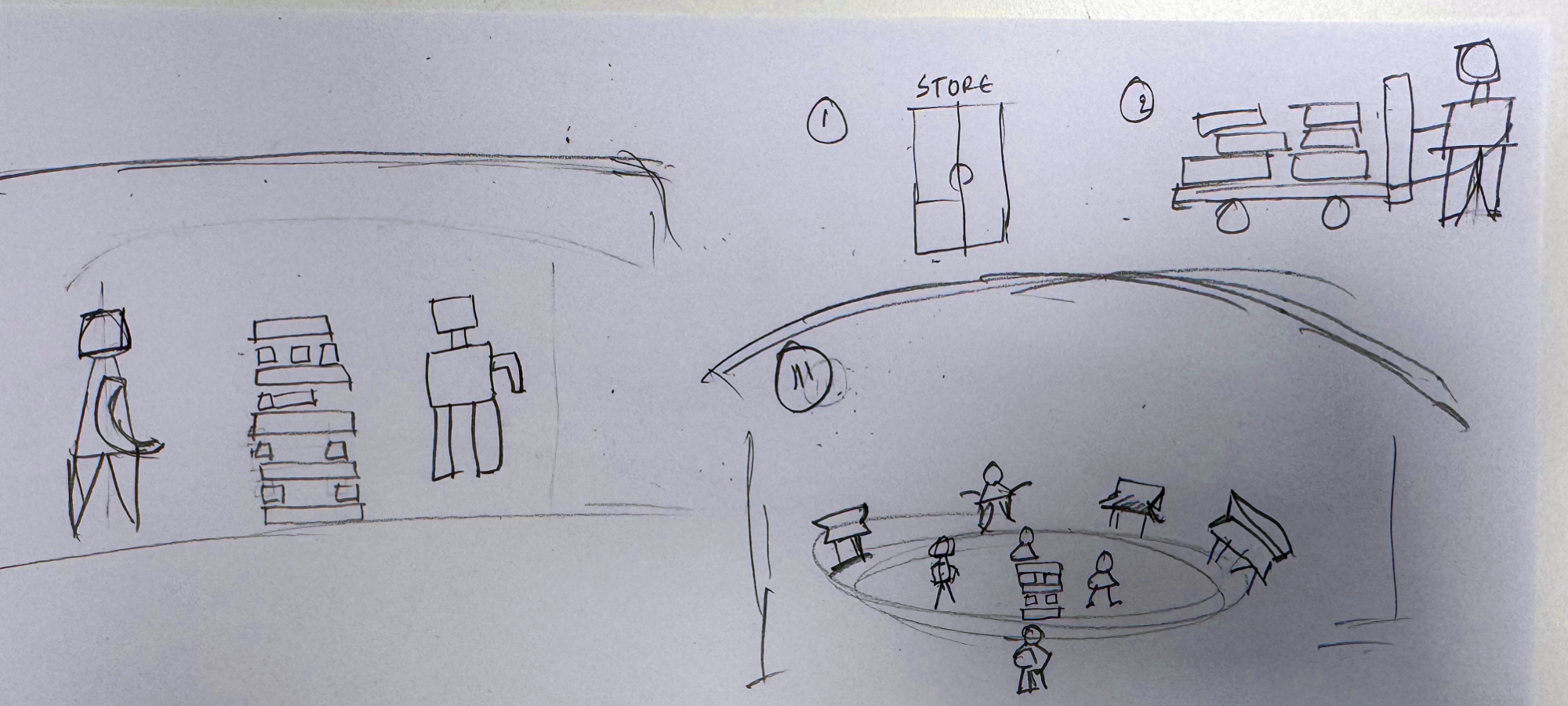
We started this project to encourage greater use of outdoor spaces. From our first ideation session, we focused on creating a playful experience by adapting a traditional board game for outdoor use. We looked into scaling up Jenga. However, the weight of the pieces, storage, and transport to the designated outdoor spot were challenging, and there was uncertainty about whether it would be played outside or inside. We considered Snakes and Ladders as well, but we have very few available square spaces on campus.
Through our research, we found that completing a guided mindful walk can reduce anxiety and stress while increasing mindfulness among university students (Burdick & Camhi, 2024). Also, students exhibit consistent preferences for areas on campus with high levels of greenery, diverse trees and flowers, and views of blue spaces, as well as for peacefulness and quietness(Aghabozorgi et al., 2025). These findings shaped our project requirements. We needed a project that uses a campus path, green and open space, suitable for an individual or a small group of friends in any season, and a game that requires walking.
We designed a game where someone can become the characters. It starts with picking up a paper ticket with the backstory and objectives written on it, along with 5 missions and a map showing all the locations. Each location is a point on campus where we would install a box with a distinct-shaped punching machine. The player must reach it on foot and use the machine to punch a hole in the ticket. After collecting all 5 holes, they are eligible for a prize.
Nonetheless, while talking to stakeholders, we realized it's not appealing to complete the walk once you know the whole story in the ticket. And if we want to provide part of the story at each station at the beginning of the mission, it's not possible, given the randomness of the story and map locations.
Finally, after a month into the design process, we decided to make this a mobile game, which solved issues like the start location and getting the next part of the story, as well as the challenges of paper management and fraud prevention. Since people can start from any location, we reduced the mission to 4.
Prototyping
While working on the project, we deployed different prototyping techniques. As rough sketching is the simplest form of prototyping(Lim et al., 2008), we often use it to communicate design ideas.
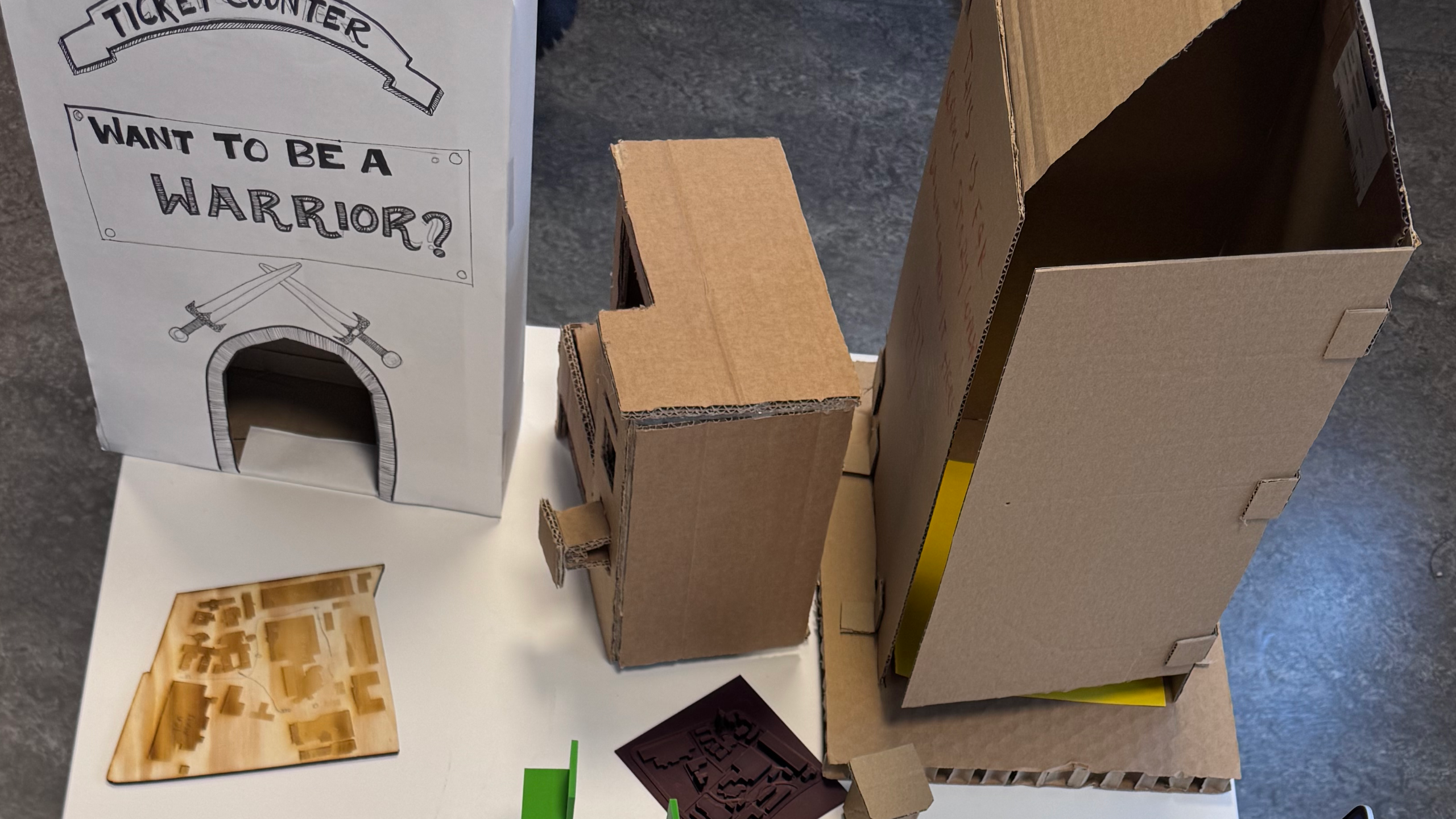
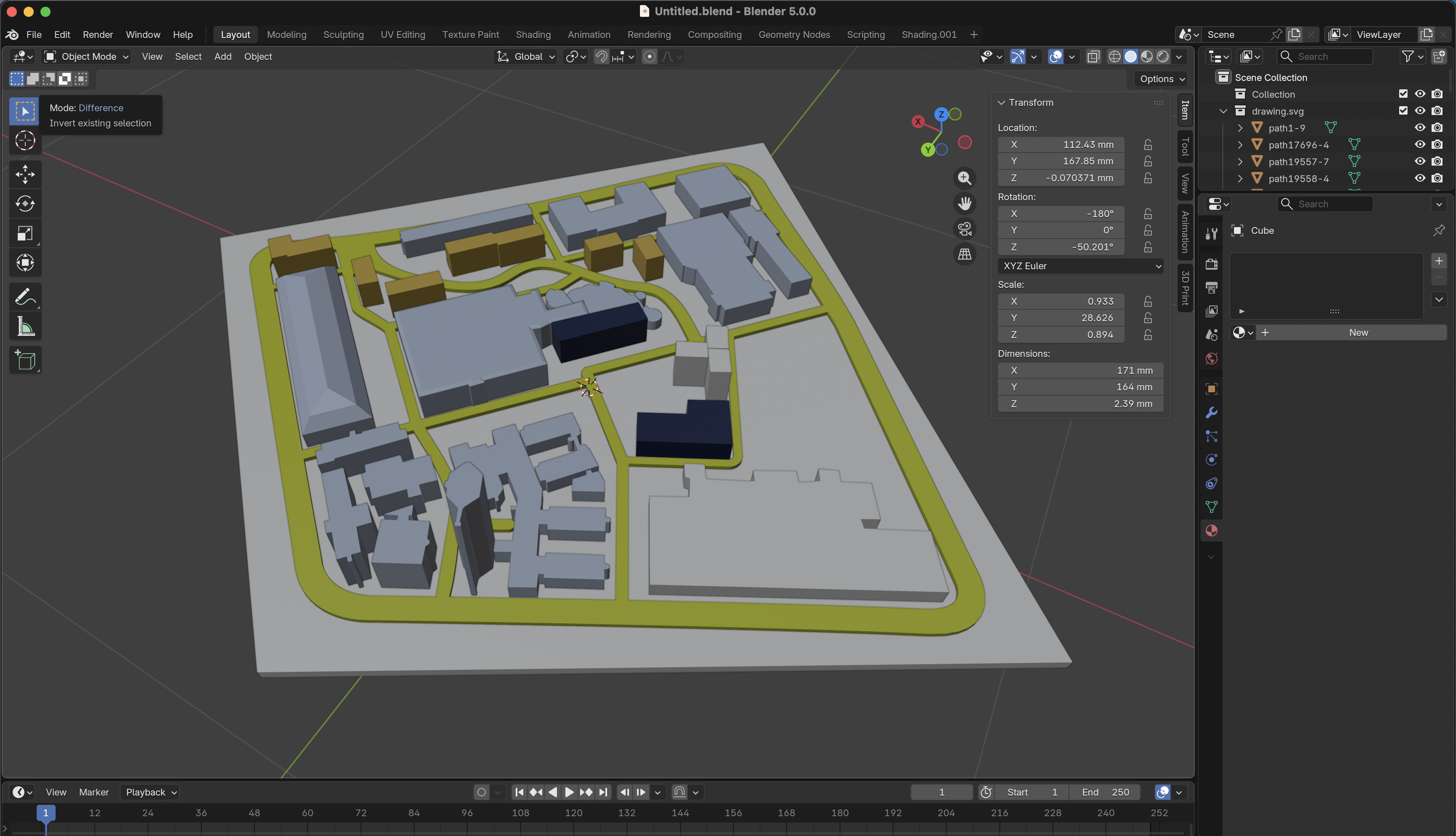
When we worked on our story idea of physical tickets, we used cardboard to model different dimensions for the station design. We wanted to use it to store our tickets and the punching machines. To understand the campus area, we created a 3D-printed map highlighting the tall buildings and walking pathways.
Then, upon deciding to use mobile games for our project, we used Figma to create an early-stage clickable prototype. Which we then used for usability testing. We opted for a slightly higher-fidelity design to help users understand the game's graphics. Instead of creating the story and character images ourselves, we used AI (ChatGPT) to generate them more quickly.
Finally, we used 3D printers to print a series of models of outdoor stations to test specific usability, structurel and aesthetic hypotheses.
Information Architecture
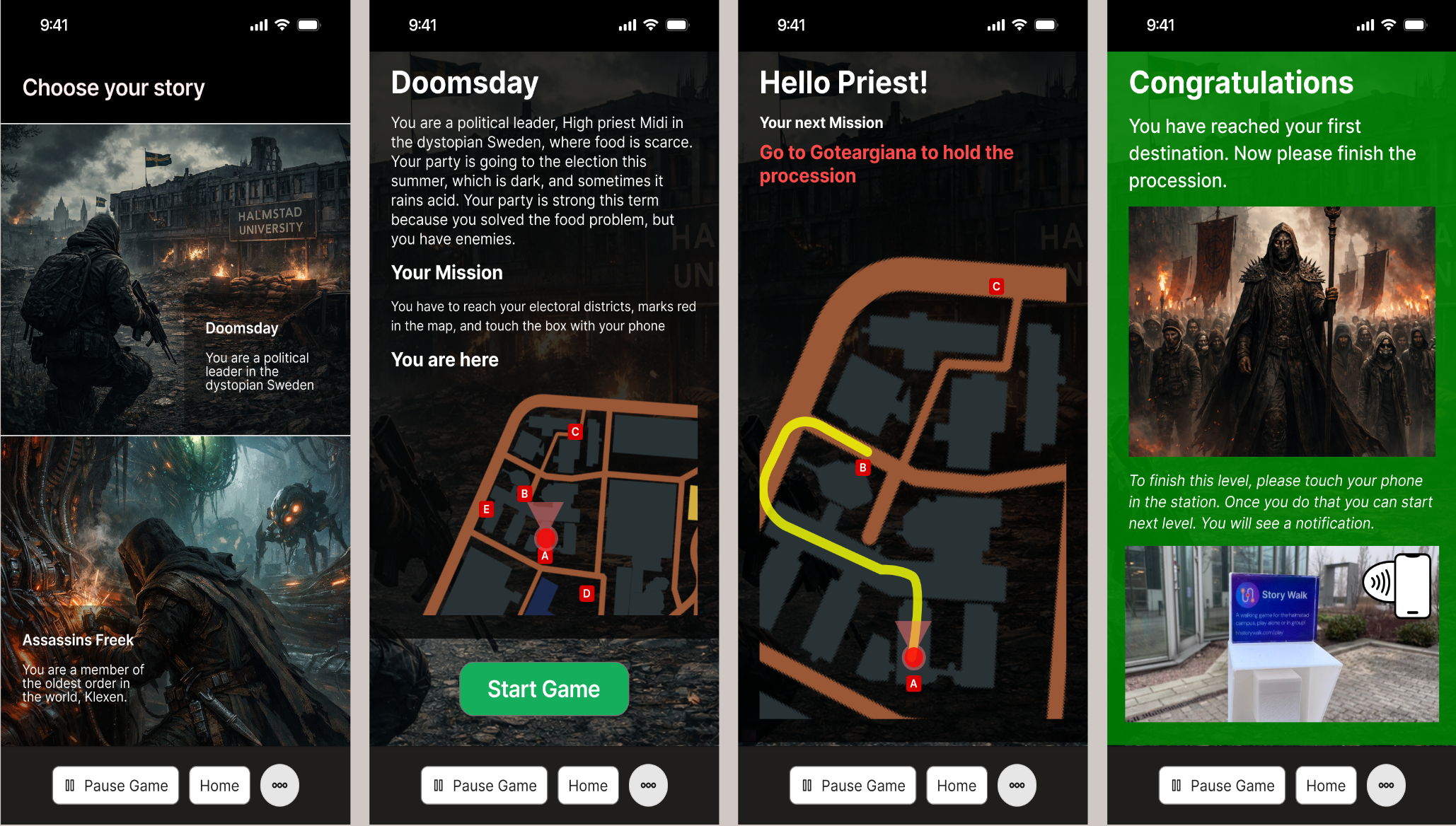
The system we designed has two parts. The first part is the mobile app, which involves listing stories; each story has its own home screen. We kept it small with only an action button to start the game. However, to pause or go back, we have a dedicated bar in the same place on all screens.
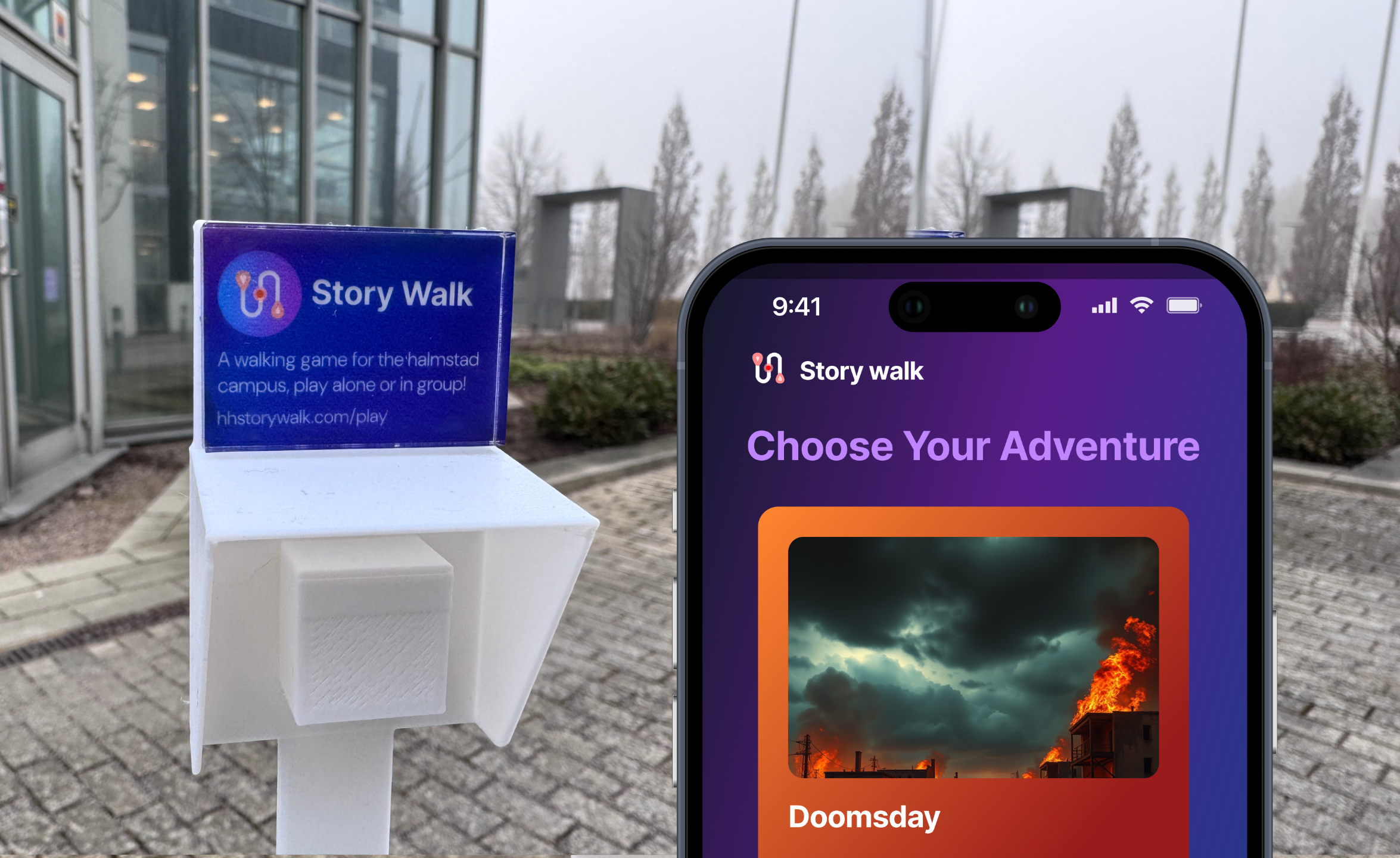
The second part is stations around the campus; we kept them simple and recognizable, with a signboard and branding that match the app. We kept the messaging simple and included a URL, so if we change something in the app, we wouldn’t need to update the signboards; we would only update the link page.
Design Process
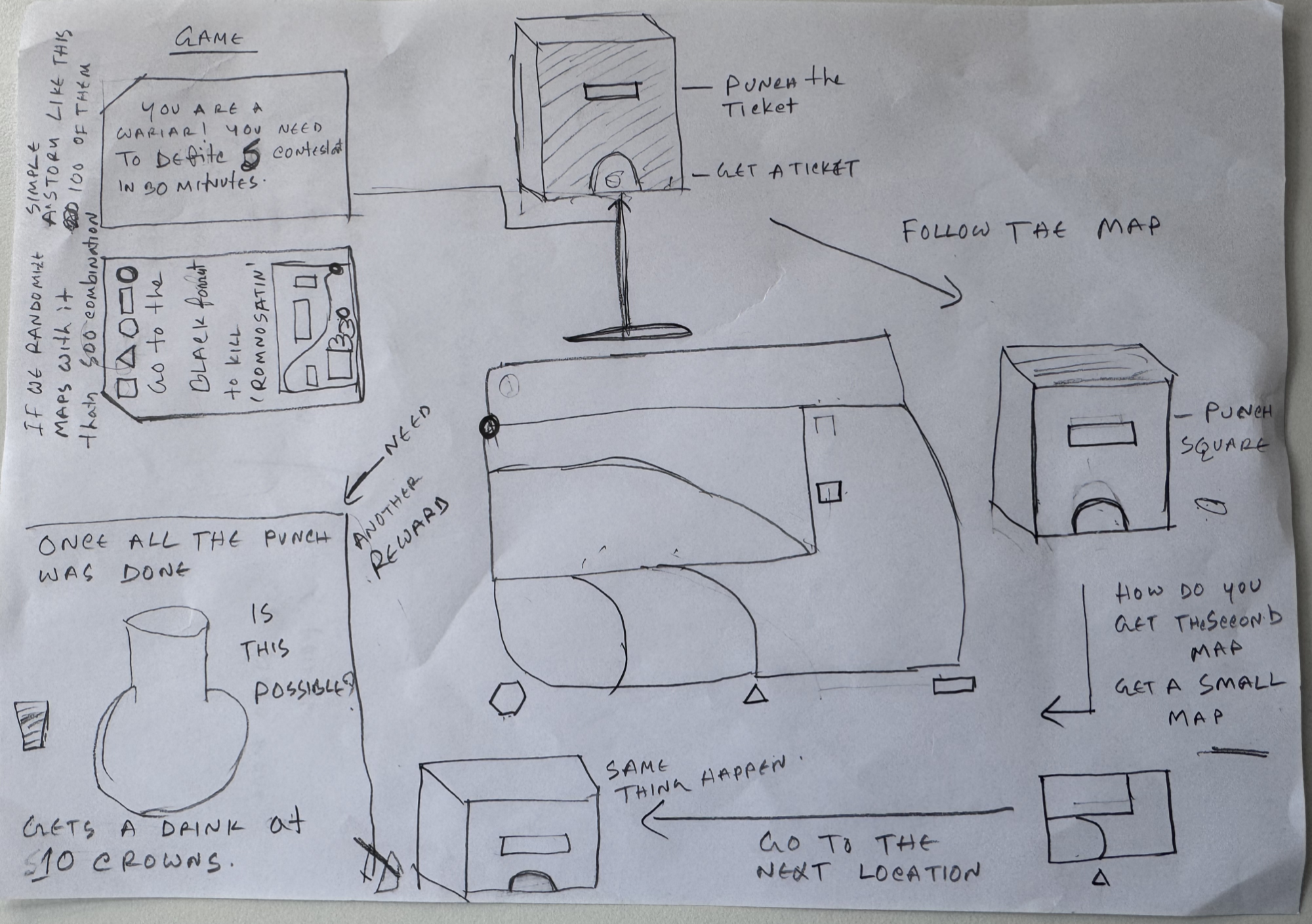
Our mission revolved around walking and storytelling from the early stage of the ideation process. We often sketched to understand the game's flow. Made prototypes to visualize objects to clear understanding. Once our first mobile wireframes were ready, we started working on the game's details.
We wrote some stories for our earlier version of the game, but the mobile version also required narration for each mission. We wrote the texts, the game narration, and the turn-by-turn voice navigation. For faster prototyping, we used Amazon Polly and ElevenLabs to generate text-to-speech. Later, we used Mixpad and GarageBand to add sound effects to create the illusion of our story's timeline, which is set in dystopian Sweden. We collected all the required sounds from Pixabay.com.
We used Figma to prototype, but it lacked audio support, so we had to convert the audio to video in iMovie with a black screen. Then we used the video files at a very low resolution to play audio.
For map information, since it's on the university campus, all the paths and hallways weren't part of Google Maps or OpenStreetMap. But then we realize we already use Mazemap on our campus, which also has an API. We decided to use it, but for the prototype, we created SVG maps of the campus paths.
We tested with some students from the studio, but due to different walking speeds, our audio didn’t match during turn-by-turn directions. We fixed it after several rounds of trial and error, at an average speed.
Final Prototype
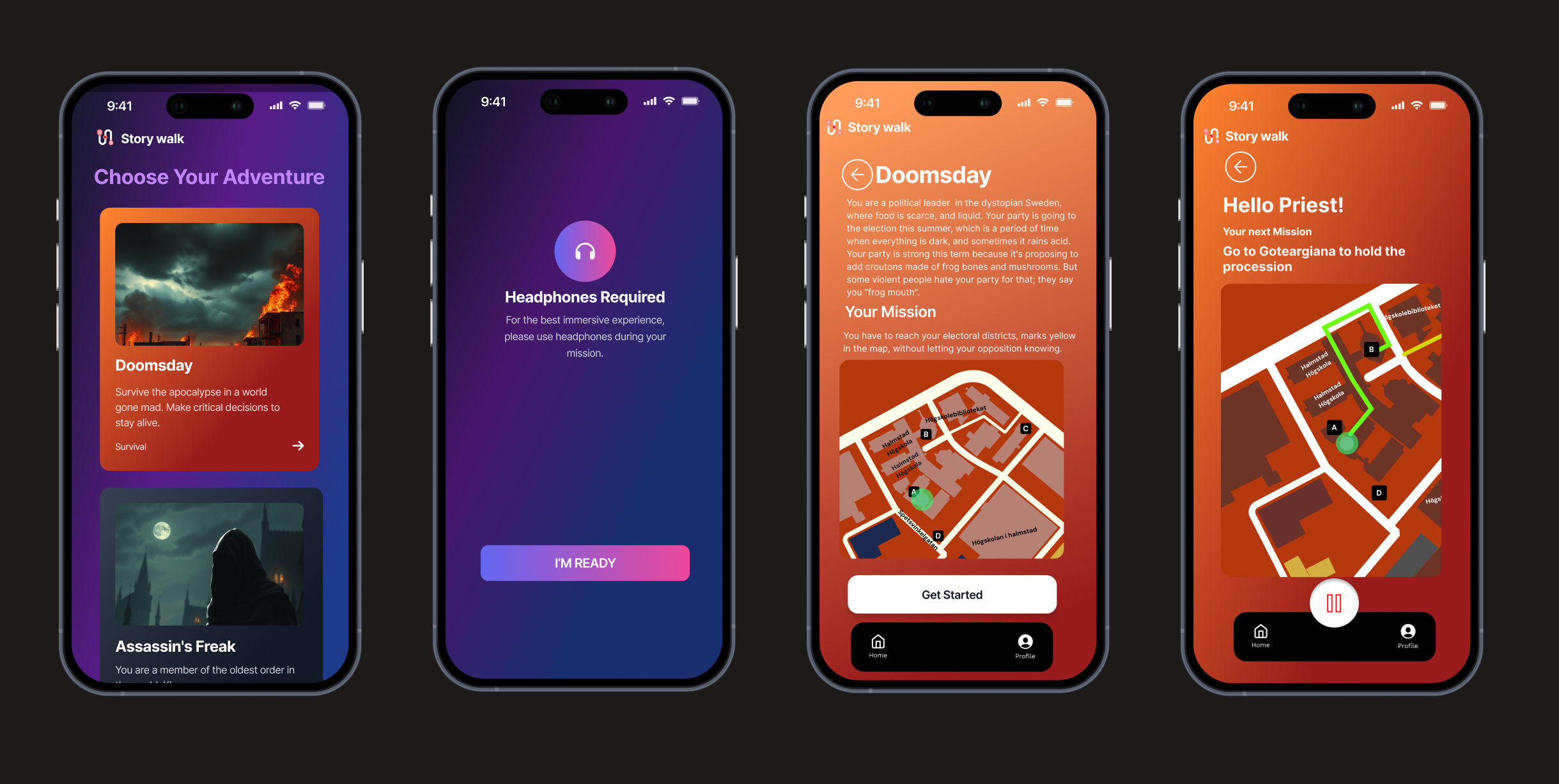
The final prototype consisted of a single game, narrated from start to finish. Each game consists of 4 missions, which are chosen at random from 10 points around the campus. If any person is near any station, that station would be avoided. So if the player is playing for the second time or when 10 players start playing, not everyone will get the same missions.
Learning
As a digital designer, I had worked with various prototype dimensions, but all were for screens. In this project, I worked with physical materials, including cardboard, 3D printers, a UV printing machine, and laser cutters. For 3D printers, I had to learn 3D software like Blender, and for sound effects, I had to learn sound editing and mixing. These learnings made me a better designer by teaching me to shape myself to project needs.
Also, for this project, we participated in two design sprints and one design residence session. Both helped me overcome my procrastination by teaching me to start designing with some restrictions, such as a time limit.
However, with high learning opportunities, there were some areas where I could have improved. One such thing is keeping the stations necessary for taping the phone. It breaks the immersive flow and burden player with cognitive load. Instead, we could’ve used other technology, e.g., GPS, to track mission completion.
Finally, the game was simple enough to make students and staff walk to a known place with a different identity in each story, which made it fun and a topic to discuss among friends, and these walks helped them mentally. Also, with little change to the system, we could create an accessible version of the game.
References
- ASHLEY A V BURDICK, SARAH M CAMHI (2024). The Effects of a Guided Mindful Walk on Mental Health in University Students
- Koorosh Aghabozorgi, Alexander van der Jagt, Simon Bell, Harry Smith (2025). The role of university campus landscape characteristics in students’ mental health
- Lim, Y.K., Stolterman, E., and Tenenberg, J. (2008). The anatomy of prototypes: Prototypes as filters, prototypes as manifestations of design ideas.